Some of our markers are developed exclusively for a specific customer, while others are based on further analysis, processing, and validation of open-source information.
Below you can find information for a selected bunch of important tomato trait markers. All markers are available as part of a multiplex- up to 30-50 and more markers- as full service. Some of the markers can also be provided as ready-to-use kits. If you have some other traits of interest not listed here, like other tomato traits, or traits for other crops, please talk to us. Tailored marker development is always welcome.
Aff All flesh fruit
Tomato is a fleshy fruit characterized by an incredible diversity of shape, colour and texture. This diversity, whether of natural or induced origin, offers formidable levers for genetic improvement of these traits to the satisfaction of consumers, processors and producers. All-flesh tomato cultivars are devoid of locular gel and exhibit enhanced firmness and improved postharvest storage.
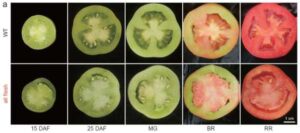
https://academic.oup.com/jxb/article/73/1/123/6365738
https://www.nature.com/articles/s41467-021-27117-7
Alcobaca
Alcobaca is commonly regarded as an abnormally ripening mutant of the tomato (Lycopersicon esculentum Mill.). Post-harvest shelf life of tomato fruit may be increased by deploying mutant alleles which affect the natural ripening process and/or by a favorable genotypic background. Among the several ripening mutant genes, alcobaça (alc) has proved to be highly efficient in increasing shelf life of commercial tomato fruits, especially in heterozygosis, a state at which no limiting deleterious effects upon fruit color occur.
https://www.researchgate.net/publication/229925847_Physiology_of_the_tomato_mutant_alcobaca
https://www.scielo.br/j/sa/a/vSjfBPWCWqwnR7rbMWYVyxd/?lang=en
Anthocyanins
The term “anthocyanins” was first used in 1835 by L.C. Marquart to indicate the blue pigments of flowers. Purple tomato fruits are now one of the many variants of color offered on the market to consumers. Because tomato is one of the most consumed vegetables all over the world, anthocyanin-enriched tomatoes can provide our diet with the beneficial amount of antioxidants that preventive medicine recommends. A great variation in size, shape, and color exists in the modern tomato varieties.
Some cultivated varieties show dark skin color (“black” or “purple”) as a result of mutations in carotenoid biosynthesis or chlorophyll breakdown. The red color of the tomato fruit results from the accumulation of lycopene, the most abundant carotenoid in the fruit. Conventional tomato genotypes accumulate anthocyanins on vegetative tissues, but not on fruit. On the contrary, the fruit of different wild Solanum species, closely related to cultivated tomato, accumulates anthocyanins in the peel.
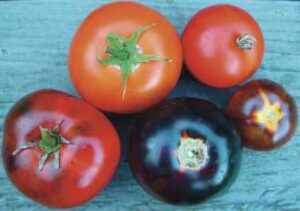
https://academic.oup.com/plphys/article/182/4/1841/6116463
https://www.frontiersin.org/articles/10.3389/fnut.2019.00133/full
Brachytic
The tomato brachytic (br) locus is a primary source of reducing stem length. The plant br locus influences stem growth in grain/fruit crops, contributing to shorter plant architecture (Hollender et al., 2016; Knöller et al., 2010; Xing et al., 2015) and suggesting that utilization of this locus may have benefits for crop production (Salamini, 2003). Introduction of the tomato br into normal phenotype tomatoes has shorter internodes that inevitably reduce stem length (Balint-Kurti et al., 1995; Barton et al., 1955; MacArthur, 1931). The locus is the primary source of the shortened internode phenotype in fresh-market tomato breeding programs (Frasca et al., 2014; Scott et al., 2010; Tigchelaar, 1986).
https://journals.ashs.org/jashs/view/journals/jashs/143/4/article-p239.xml
EI (Elongated Internode)
Internode length is an important agronomic trait affecting plant architecture and crop yield. Plant height is an important component of plant architecture and is highly correlated with yield. One of the decisive factors affecting plant height is internode length. The reduced plant height or internode length of semi-dwarf varieties has improved the harvest index and biomass production. https://www.ncbi.nlm.nih.gov/pmc/articles/PMC6540210/
Fruit firmness
Fruit firmness in tomato (Solanum lycopersicum) is determined by a number of factors including cell wall structure, turgor, and cuticle properties. Firmness is a complex polygenic trait involving the coregulation of many genes and has proved especially challenging to unravel.

Fruit firmness tester
https://academic.oup.com/plphys/article/159/4/1644/6109498
Green-Stripe
Stripe phenotype is a common phenomenon in nature and can be observed in a wide range of organisms, including butterflies, maize, apple, watermelon, and flowers. The fruit stripe color pattern is determined by the green stripe (gs) locus and is observed only in the peel tissue in tomato.
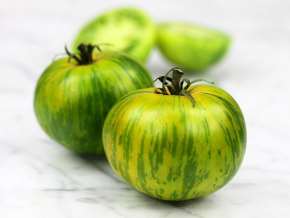
https://nph.onlinelibrary.wiley.com/doi/10.1111/nph.16705
Potato-leaf
“Potato leafed” is an old and well-known trait in tomato breeding, discussed in the scientific literature by White (1901) and described as a recessive Mendelian gene by Price and Drinkard (1908).
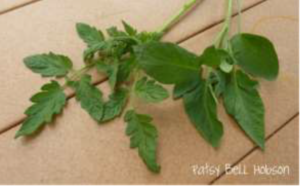
Potato Leaf or Regular Leaf Tomato Varieties
https://www.ncbi.nlm.nih.gov/pmc/articles/PMC3229137/
https://solgenomics.net/locus/1201/view